
Until this week, OpenSpec Workbench knew one way to open a pull request,
check it, and merge it: gh, GitHub's own CLI. If your repository lived on
GitLab or Gitea, or if gh simply was not installed, the archive stage said
so and stopped. That is fixed now, on all three, and the way it got fixed is
the more interesting part.
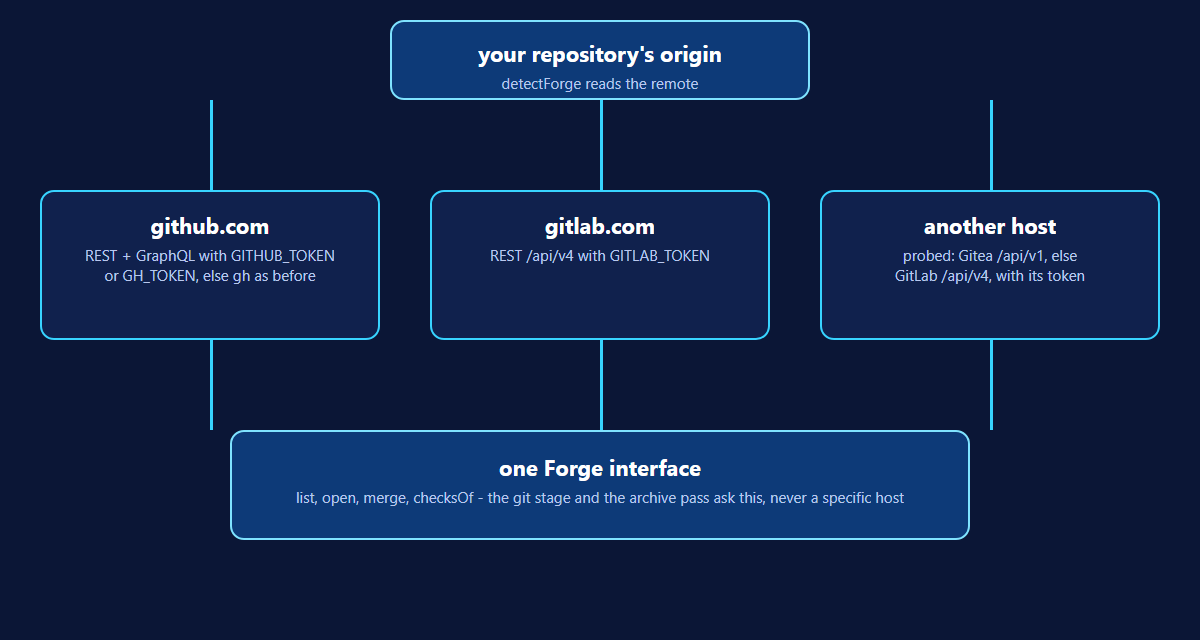
The interface, not the tool
The fix is not "support GitLab too" bolted onto the GitHub path. It is one
Forge interface - list a pull request by branch, open one, ask for a merge,
read its checks - that the git stage and the archive pass call without
knowing which host answers. Three implementations sit behind it: GitHub's
own REST and GraphQL, GitLab's REST API, and Gitea's. Which one runs is
decided once, by reading the repository's own origin: github.com is
GitHub, gitlab.com is GitLab, and anything else is probed - Gitea's
/api/v1/version first, then GitLab's /api/v4/version - so a self-hosted
instance is found without being told what it is.
The token decides the way, even for GitHub
GitHub is the one host that had two paths from the start: gh, or now its
own API when GITHUB_TOKEN or GH_TOKEN (the same variable gh itself
reads) is set in the environment. Without one, the product goes through
gh exactly as before - this did not become a breaking change for anyone
already running it. Where neither a token nor gh is available, the
reading says so plainly: "gh is not installed, and GITHUB_TOKEN is not
set", rather than failing on a command that was never going to work.
What running it against real hosts found
Reading a REST API's documentation and calling it in anger are two different exercises, and this is where the honest part of the story is.
Gitea was tested live on 1.26.4, in a throwaway repository deleted after each run. Two behaviours needed handling that no amount of reading would have surfaced: a repository with a single branch answers a pull request listing with 404 rather than an empty list, and a merged pull request's head can report a label naming a branch that no longer exists. Handled once, both stay handled everywhere Gitea is the forge.
GitLab was tested live on gitlab.com, in a throwaway private project.
The first token given for it was fine-grained without quite enough scope,
and GitLab said so plainly (insufficient_granular_scope) rather than
failing silently. Once a token with the right scope was in place, the
first merge attempt was refused with a 422, "Branch cannot be merged" -
not because it could not be merged, but because GitLab had not yet finished
deciding whether it could. The forge now waits and asks again before
believing a 422. On both hosts, once that was in place, the full path ran
end to end with the real archive command: it found the finished change,
opened a pull request, watched it merge by itself, and the repository held
the archived change afterward, spec applied.
GitHub's own API was tested live too, on 2026-09-22, with gh's own
token handed to the process as GITHUB_TOKEN and gh itself kept off the
PATH - so there was no fallback to quietly catch a mistake. Against this
repository it read 147 pull requests and a real check run as a pass,
read-only. Against a fresh throwaway repository, the first automatic merge
was refused outright: "Auto merge is not allowed for this repository",
GitHub's own setting on a brand-new repo. The archive pass left the pull
request open and said why, exactly as the project's own rule requires
rather than pretending the merge had happened. Turning the setting on let
the same request merge by squash. A second pull request, opened to test
what the git stage's own gateway does with no checks configured at all,
correctly read "no check result was available" and declined to merge -
absence of information is not the same as a green light.
What this does not cover
GitHub Enterprise Server is not detected as its own case. A host that
answers neither Gitea's nor GitLab's version probe is assumed to be GitHub
and handled through gh, which already knows how to reach a GitHub host of
its own. The allowlist that gates what the git stage may push, create or
merge still speaks in gh's own terms - the remote and the branches it
names - regardless of which forge actually does the work underneath.
Try it
The code is at github.com/VeryComplexAndLongName/OpenSpec-UI, where the repository and packages keep the name OpenSpec-UI. The core this rests on is described in One core, two hosts.
Where each claim comes from
- The
Forgeinterface, the three implementations and how one is chosen: the archived changesthe-forge-is-gitlab-or-gitea-tooandgithub-without-gh. - The Gitea and GitLab live findings (the 404, the stale branch label, the
scope error, the 422-until-decided):
the-forge-is-gitlab-or-gitea-too's owntasks.md, task 3.2 and 3.3. - The GitHub API live findings (the 147 pull requests, the refused
automatic merge, the "no check result" case):
github-without-gh's owntasks.md, task 4.2. - Which forge, which token, and the exact reading when neither a token nor
ghis available: HARNESS.md. - What this does not cover:
github-without-gh's proposal, "Explicitly out of scope".