
stepAgents has let you name a different agent for propose, review, apply
and verify since 0.42. What is new is a reason to actually do it: the four
stages do not cost the same thing to run well, and they do not need to.
Deciding what a change should do and reading whether the result is right both
call for judgement. Writing the diff that gets there is comparatively
mechanical - which is not an insult to the work, it is why a cheap, fast model
does it about as well as an expensive one. So the obvious split is: a capable
agent on propose and review, and a cheap one on apply. This is that
split, what it costs at today's prices, and - the part worth reading past the
headline number - exactly what this project's own telemetry can and cannot
prove about the savings.
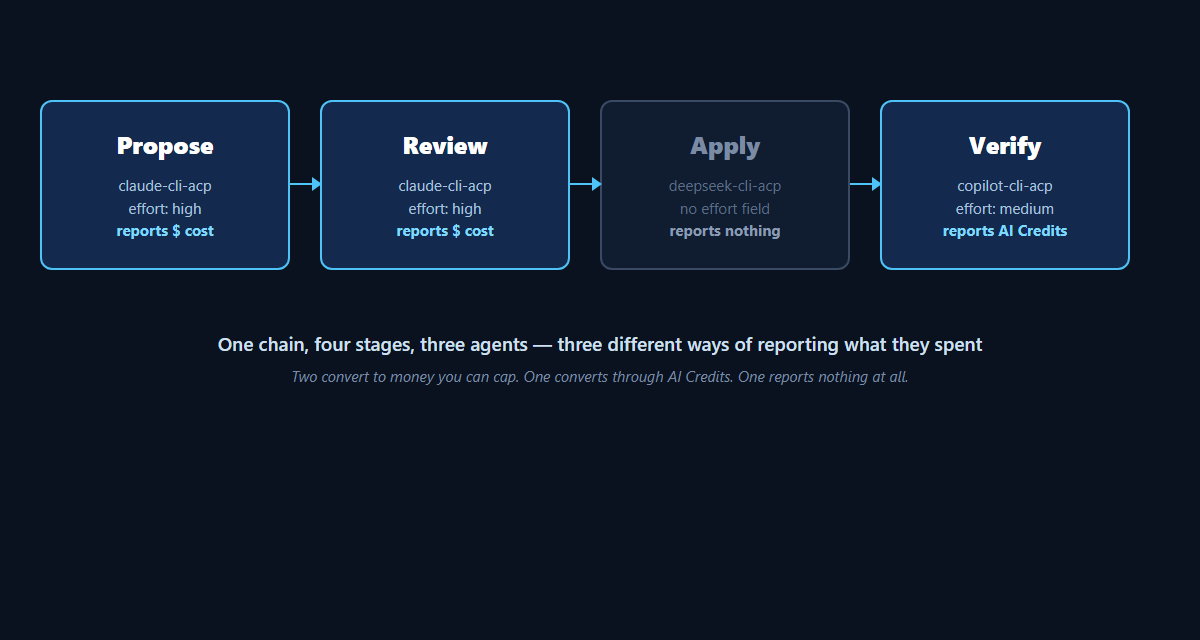
The four stages take different things seriously
A harness.json entry accepts agent, model, effort, budget and
customAgent - and only propose, review, apply and verify accept a
stepAgents entry at all; archive and git are mechanical, with nothing to
configure. A model is only accepted for the four adapters whose registry
entry declares a --model flag: claude-cli, copilot-cli, claude-cli-acp
and copilot-cli-acp. budget is maxCostUsd or maxAiCredits, whichever
unit the chosen agent's own capabilities accept - the other is rejected.
{
  "stepAgents": {
    "propose": { "agent": "claude-cli-acp", "model": "claude-opus-5-5", "effort": "high", "budget": { "maxCostUsd": 5 } },
    "review":  { "agent": "claude-cli-acp", "model": "claude-opus-5-5", "effort": "high", "budget": { "maxCostUsd": 3 } },
    "apply":   { "agent": "deepseek-cli-acp" },
    "verify":  { "agent": "copilot-cli-acp", "effort": "medium", "budget": { "maxAiCredits": 200 } }
  },
  "timeout": { "maxStageSeconds": 2700 }
}
propose and review above pin claude-opus-5-5 at high effort, with a
dollar ceiling each. claude-fable-5-1 is the other reasonable choice for
either - cheaper per token, still a model built for judgement rather than
throughput; which of the two is worth its price on your own changes is
something to measure, not assume. apply carries no model, no effort and
no budget at all, and that is not an oversight: deepseek-cli-acp accepts
none of the three. Its model is a session option this project's driver never
sends, so DeepSeek's own default runs; nothing here can raise or lower how
hard it thinks.
What the harness can prove, and what it flatly cannot see
This is the part a "save money" article usually skips, and it is the most useful thing this one has to say.
Two of the three agents in this split convert cleanly to a ceiling you can
actually set. claude-cli-acp reports a cost figure directly - measured in
this repository on 2026-09-05, one stage: 60 input, 8,262 output and
1,693,507 cache tokens for $1.57, and budget.maxCostUsd compares
against exactly that number. copilot-cli-acp reports no dollar figure, but
it reports AI Credits, which are not a proxy this project invented - they
are the unit Copilot itself bills in, 1 credit = $0.01 - so
budget.maxAiCredits is a real ceiling in real money, just denominated
differently. Two agents, two currencies, both enforceable.
deepseek-cli-acp is the one genuine blind spot. Measured 2026-09-23, its
one usage figure is a context gauge - tokens used against the model's
window - never a cost, a credit count or even a token split. budget has no
mechanism to set on it, in either unit, because there is nothing to compare
a ceiling against.
So the honest description of the harness.json above is: three of the four
stages carry a leash denominated in real money - two in dollars, one in AI
Credits - and the cheap one does not. timeout.maxStageSeconds still bounds
how long apply can run, because elapsed time needs no report from the
agent - but nothing in this product will tell you, or stop you, if a
deepseek-cli-acp stage is burning through a prepaid balance faster than
expected. That balance lives entirely on DeepSeek's side. Watch it there.
Two more limits worth knowing before you lean on the cheap stage. Neither
copilot --acp nor dsh (DeepSeek's CLI) asks for permission before writing
a file or running a command, despite the Agent Client Protocol supporting the
mechanism - both were observed completing writes and shell commands here
without ever raising session/request_permission. Cheaper is not the same as
better-supervised; the review gate between apply and verify is what is
actually watching this stage, not the permission channel. And dsh needs
Node 22.18+ on the 22 line, or 24.2+ - below that floor it exits with code 0
before answering, silently. If your repository pins an older Node for its own
tooling the way this one pins 22.11 with Volta, that is the first place to
look when an apply stage using DeepSeek produces nothing.
What this costs, at today's prices
These are vendor list prices, read 2026-09-24, not a figure this project measured. Nothing here converts one into the other, and the harness has no opinion about which subscription you carry - that lives entirely outside it, in each CLI's own login.
| Setup | Monthly | Runs |
|---|---|---|
| Claude Max 5x alone | $100 | every stage on claude-cli/claude-cli-acp |
| Claude Pro + Copilot Pro + DeepSeek API credit | $20 + $10 + about $5 in tokens ≈ $35 | propose/review on Claude, apply on DeepSeek, verify on Copilot |
Claude Pro is $20/month billed monthly, $17 annually; Claude Max starts at
$100/month for the 5x tier. Copilot Pro is $10/month, including $10 of AI
Credits at 1 credit = $0.01 - which is also where budget.maxAiCredits's
minimum of 30 comes from: thirty cents is the smallest ceiling the product
will accept, because Copilot itself will not meter anything finer. DeepSeek
has no subscription tier at all: deepseek-flash (what this project's own
measurement on 2026-09-22 recorded as DeepSeek-V4-Flash - names move
faster than documentation; check what dsh reports before you trust either)
prices output at $0.60 per million tokens off-peak, $1.20 during DeepSeek's
own weekday peak windows. Five dollars of prepaid credit is, at off-peak
rates, upward of eight million output tokens - many multiples of what one
apply stage moves by the only measurement available here (1.7 million
tokens, all kinds, on a claude-cli-acp stage). Read that as "a lot", not as
a number of stages: different models tokenize and work differently, and this
project has no apply-stage measurement on DeepSeek to compare it against
directly.
The arithmetic says $65 a month, and it survives the correction: GitHub's own current price for Copilot Pro is $10, not the $20 an older plan once charged, and the saving lands in the same place regardless, because the difference comes out of the Claude Max to Claude Pro step either way.
What this article is not
Not a benchmark. Nothing here measured whether deepseek-cli-acp produces
work as good as claude-cli-acp on the same apply stage - that is a
real, answerable question, and it is not this one. Not a recommendation for
your specific changes: an architecture decision or a security-sensitive
apply stage may be exactly the case where the expensive agent belongs on
every stage, ceilings included. And not a claim that Codex or Gemini would
be a worse or better third leg of this - both remain agents this project has
never run against a real binary, on any stage.
Try it
The full field reference for stepAgents, model, effort and budget is
in HARNESS.md.
Which agents report what, in which unit, is in
LIMITS.md.
The code is at
github.com/VeryComplexAndLongName/OpenSpec-UI,
where the repository and packages keep the name OpenSpec-UI.
Where each claim comes from
stepAgents, its four fields, which stages accept it, and which agents accept amodel: HARNESS.md, "stepAgents".- The agent capability table (
model,effort, spending-cap unit, run against a real binary): HARNESS.md, "Agents, models, effort, and spending caps". - Which agents report usage, in which unit, and the $1.57 and 1,701,829-token measurements: LIMITS.md, "Which agents report usage".
deepseek-cli-acp's context gauge, its measurement date, and that it reports no cost, no credits and no token split: LIMITS.md, the same section, and the archived changea-run-can-outgrow-its-context.- Neither
copilot --acpnordshasking for permission, and the Node 22.18+/24.2+ floor: HARNESS.md, "ACP effort and budget capabilities", and the article A new agent, and nothing else moved. - Claude Pro and Max prices: claude.com/pricing, read 2026-09-24.
- Copilot Pro's price and its AI Credits: GitHub's own announcement, read 2026-09-24.
- DeepSeek's per-token prices and peak windows: DeepSeek's own pricing page, read 2026-09-24.